
Week of June 8
Monday/Tuesday
Movie analysis, AP lab clean-up and restocking of lab drawers.Collect textbooks.
Wednesday/Thursday
Polysaccharide lab. Review for final exam.
Friday
Finish movie analysis.
Week of June 1
Monday
Review organic nomenclature, organic reactions.
Tuesday
Quiz on chapter 15
Wednesday/Thursday (double)
Copper plating lab
Wednesday/Thursday (single)
Alchemist's Dream: copper to gold
Friday
Solution prep for 14 Unknowns lab.
Week of May 25
Monday
No school
Tuesday/Wednesday
More organic chemistry: name alcohols, amines, esters, acids. Note: fly balloons in period 15, weather permitting.
Thursday/Friday
Organic reactions, some bio and polymer chemistry.
Week of May 18
Monday/Tuesday
Finish hot air balloons, to be ready to fly on Wednesday
Wednesday
Fly hot air balloons, weather permitting.
Thursday/Friday
Start chapter 15, Organic Chemistry
Week of May 11
By Wednesday, bring in at least 32 sheets of tissue paper for the hot-air balloon project.
Monday/Tuesday
Objectives: students will be able to
1. relate the stability of the nucleus to number of protons and neutrons
2. explain zone of stability on a graph of number of neutrons vs. number
of protons
3. classify types of radioactive decay
Procedure: cover sections 24.1 and 24.2
Textbook problems, pp. 1079 - 1080, 5,6, 11-22, 41-46.
Tuesday/Wednesday
Objectives: students will be able to
1. discuss effects of radiation.
2. calculate the half-life of an isotope
Procedure: cover section 24.2, review for chapter 24
quizzowie.
Wednesday/Thursday/Friday
Make a model hot-air balloon, then work on hot-air balloons in class.
Week of May 4
Monday
Most students will take the AP chemistry test
Tuesday
Students will read and take notes on chapter 24, Nuclear Chemistry
Wednesday-Friday
Objectives: students will be able to
1. relate the stability of the nucleus to number of protons and neutrons
2. explain zone of stability on a graph of number of neutrons vs. number
of protons
3. classify types of radioactive decay
4. discuss effects of radiation.
5. calculate the half-life of an isotope
Procedure: cover sections 24.1 and 24.2
Wednesday/Thursday
Objectives: students will be able to
Procedure: collect lab reports, cover section 24.2, review for chapter 16/24
test.
Homework: study for a test on chapters 16 and 24.
Week of April 27
Monday-Wednesday
Practice test 1.
Thursday/Friday
Practice test 2 and review.
Week of April 20
Monday/Tuesday
Objective: students will be able to
1. define cell potentials
2. use line notation to describe electrochemical cells.
3. predict relative strengths of oxidizing and reducing agents
4. predict if a cell reaction is spontaneous
5. calculate equilibrium constants from cell potentials
6. state the dependence of cell potential on concentration (Nernst equation)
Procedure: then cover sections 21.1-21.3. Distribute problem set to follow
during class.
Homework: pp. 967-968, 10-13, 22-34, due Tuesday.
Wednesday/Thursday
Objectives: students will be able to
1. describe the composition of common batteries and explain their operation
2. explain corrosion
3. describe the stoichiometry of electrolysis
4. calculate mass of products formed during electrolysis
Procedure: cover sections 21.4 - 21.7.
Homework due for review Thursday: pp. 968-969, 38,39, 44-47, 56-59, 66, 67
Friday
Students will take a test on chapter 21.
Week of April 13
Due Monday, practice AP test, to be collected to check for effort.
Monday/Tuesday
Objective: students will be able to
1. define free energy of formation and use it to predict spontaneity
2. calculate free energy given pressure of reactants
3. explain the meaning of the change in free energy for a chemical reaction
Procedure: cover sections 20.3 and 20.4. Review using AP test questions on
entropy and free energy.
Wednesday
Objective: students will be able to demonstrate knowledge of the laws of thermodynamics.
Procedure: administer quiz on chapter 20.
Thursday/Friday
Objective: students will be able to
1. define cell potentials
2. use line notation to describe electrochemical cells.
3. predict relative strengths of oxidizing and reducing agents
4. predict if a cell reaction is spontaneous
5. calculate equilibrium constants from cell potentials
6. state the dependence of cell potential on concentration (Nernst equation)
Procedure: then cover sections 21.1-21.3. Distribute problem set to follow
during class.
Homework: TBA, due Monday.
Week of March 30
Monday
Review for chapter 19 test.
Tuesday
Chapter 19 test, computer lab to graph pH curve for lab report, due Wednesday.
Wednesday/Thursday
Start chapter 20 on thermodynamics, entropy. Distribute assignment for Spring Break.
Friday
Spring Break begins.
Week of March 23
Monday/Tuesday (double period)
Objectives: students will be able to determine by titration the molarity
of a sodium hydroxide solution, determine the molar mass of an unknown
acid.
Procedure: students will perform Acid/Base Titration, experiment 15-2 in
Chemistry Concepts and Applications. Students will use a pH meter for the
second part of the lab, allowing them to calculate the acid dissociation
constant, Ka, of the unknown acid.
Monday (single)Wednesday/Thursday
Objectives: students will be able to describe titrations (weak acid/strong
base, weak base/strong acid), solve titration problems, describe pH curves
of monoprotic and polyprotic acids, determine equivalence points, determine
applicability of acid-base indicators.
Procedure: cover section 19.2. Show Excel spreadsheet treatment of a titration
problem, used to solve repetitive calculations and to graph pH vs. titrant
volume.
HW due Wednesday p. 870, 50,51,54-59
Wednesday/Thursday (single period) and Friday
Objectives: students will be able to
1. calculate Ksp given solubility
2. calculate solubilities from Ksp
3. calculate effect of common ions on solubility
4. effect of pH on solubility
Procedure: cover section 19.3, review for a test on Monday
Demo: show precipitation of sodium chloride from water by adding common ion,
Cl- from concentrated hydrochloric acid.
Homework: p. 871, 68-75 due Friday.
Week of March 16
Monday
Test on chapter 18, acids and bases
Tuesday/Wednesday
Objectives: students will be able to
1. describe and use the common ion effect
2. define a buffer
3. calculate the pH of a buffered solution
Procedure: cover section 19.1.
Homework: pg. 869, 11,12,15,16,23,24,27,28,31,32, due Monday.
Thursday/Friday
Objectives: students will be able to
describe these titrations:
strong acid/strong base
weak acid/strong base
weak base/strong acid
solve titration problems
describe pH curves of monoprotic and polyprotic acids
determine equivalence points
determine applicability of acid-base indicators
Procedure: cover section 19.2.
Week of March 9
Homework due Monday: pp 819-820 41-44, 47-48, 55-56, 63-71, 80-81
Monday/Tuesday
Objective: students will be able to
1. calculate pH of weak base solutions
2. calculate pH of acidic and basic salt solutions.
Procedure: Cover sections to achieve above objectives.
Wednesday/Thursday
Objective: students will be able to
1. use bonding structure to explain acidic and basic properties
2. define Lewis acids and bases
Procedure: cover relevant sections in Silberberg. Distribute practice pages
for review.
Textbook problems for review on Thursday: pp. 820-821, 88-91, 100-104, 107, 108, 111, 112, 122, 123, 128, 129
Friday
Graded seatwork on chapter 18.
Week of March 2
Monday/Tuesday
Objectives: students will be able to
1. distinguish between Arrhenius vs. Brønsted-Lowry models
2. define conjugate acid, conjugate base
3. define acid strength by Ka
4. define amphoteric nature of water, pH scale
Procedure: continue with chapter 18 on
acids and bases, cover sections 18.2 - 18.3.
Homework, due Tuesday: pp. pp 817 - 818, 5-18, 23-30
Wednesday/Thursday
Objective: students will be able to
1. calculate pH and pOH of strong acid and strong base solutions
2. calculate pH of weak acid solutions including polyprotic acids
3. calculate pH of weak base solutions
4. calculate pH of acidic and basic salt solutions.
Procedure: Cover sections to achieve above objectives.
Homework, due Thursday for review, pp. 819+, 41-44, 47-48, 55-56, 63-71, 64, 88-91, 99-100, 103-104, 113-114
Friday
Quiz on chapter 18.
Week of February 23
Monday
Homework: pp. 769-770, 14-19, 28-30, 34-36, 42-46 Due for review
Finish chapter 17, review for a quizaetti on Tuesday
Tuesday
Quizzetti of chapter 17, equilibrium.
Return and review chapter 16 test (periods 3-5 and 13)
Wednesday/Thursday/Friday
Objectives: students will be able to
1. distinguish between weak and strong acids
2. distinguish between Arrhenius vs. Brønsted-Lowry models
3. define conjugate acid, conjugate base
4. define acid strength by Ka
5. define amphoteric nature of water, pH scale
6. calculate pH of strong and weak acid solutions.
Procedure: start chapter 18 on
acids and bases.cover sections 18.1 - 18.3.
Demo: show acid/base equilibria using mixtures of strong and weak acids and
bases in the presence of universal indicator, show properties of acids, bases.
Week of February 16
Monday
No school
Tuesday/Wednesday
Objectives: students will be able to
1. define chemical equilibrium
2. define equilibrium constant
3. relate reaction quotient and equilibrium constant
4. write reaction quotients for various reactions
5. compare Kc and Kp and convert from one to the other
6. solve problems involving equilibrium by writing expressions for Keq, Kp
Procedure: Start chapter 17 on chemical equilibrium. Cover sections 17.1-17.3.
Begin equilibrium problem solving, section 17.4. Distribute sample problem
sheet including table to aid in the organization of this type of problem
solving. Return and review test on chapter 16 and 24,
Homework: pp. 769-770, 14-19, 28-30, 34-36, 42-46 Due Monday.
Thursday/Friday
Objectives: students will be able to
1. solve for equilibrium concentrations given equilibrium constant
2. define and apply LeChâtelier's principle.
Procedure: cover sections 17.5-17.6, distribute and work on practice problems.
Week of February 9
Monday
Objectives: students will be able to
1.evaluate reaction mechanisms
2. define elementary steps, molecularity
Procedures: finish discussion on
reaction mechanisms, by reviewing the AP test questions, students will determine a procedure for kinetics lab.
Tuesday/Wednesday (double)
Objectives: Students will be able to
1. Determine the rate of a chemical reaction
2. Determine the rate law of a reaction
3. Work cooperatively in groups.
Procedure: students will perform a lab on reaction kinetics.
Tuesady/Wednesday (single)
Objectives: students will be able to
1. define catalysis
2. compare homogeneous vs. heterogeneous catalysis
3. discuss catalysis mechanisms and examples.
Procedures: finish discussion on
reaction mechanisms, by reviewing the AP test questions, cover section on
the kinetics model, on catalysis.
Thursday
Objective: Students will be able to solve problems on radioactive decay
Procedure: present radioactivity as an exapmle of first-order kinetics, review for a test on chapter 16
Homework: study for a test on chapters 16 and 24..
Friday
Test on chapter 16
Week of February 2
Monday/Tuesday
AP Chemistry midterm
Wednesday/Thursday
Objectives: students will be able to
1. determine reaction order of overall reaction order by interpretation of
graphical data.
2. use the integrated rate law to determine the form of a rate expression
4. define half-life
5. find rate constant knowing half-life
6. determine time of reaction to given % completion
7. graph data in Excel, plot results to determine reaction order
Procedure: Continue with chapter 16 on Chemical Kinetics, cover sections
16-3 to 16-4.
Thursday/Friday
Objectives: students will be able to
1. discuss the temperature dependence of reaction rates
2. describe the collision model
3. define catalysis
4. compare homogeneous vs. heterogeneous catalysis
5. discuss catalysis mechanisms and examples.
Procedures: finish discussion on reaction mechanisms, by reviewing the AP
test questions, cover section on the kinetics model, on catalysis.
Homework: pg 722-723,26-29, 34,35,38,39,41-44 due Monday
Week of January 26
Monday/Tuesday
Midterm in class
Wednesday-Friday
Midterms
Week of January 19
Monday
No school
Tuesday
Objectives: students will be able to
1. define reaction rate
2. describe factors that influence reaction rate
3. distinguish between average, instantaneous and initial rates
4. interpret a graph of concentration vs. time
Procedure: Begin chapter 16 on Chemical Kinetics, cover appropriate sections
in Silberberg.
Wednesday
1. define rate law
2. determine reaction order of individual reactants
3. determine reaction order of overall reaction order by interpretation of
graphical data.
Procedure: Continue with chapter 16 on Chemical Kinetics, cover sections
16-2 to 16.3.
Thursday
Objectives: students will be able to
1. determine reaction order of individual reactants
2. determine reaction order of overall reaction order by interpretation of
graphical data.
3. use the integrated rate law to determine the form of a rate expression
4. define half-life of second order and zero order reactions
Procedure: Continue with chapter 16 on Chemical Kinetics, cover sections
16-3 to 16-4.
Friday
Hand out review packet for mid-term.
Week of January 12
Homework due Tuesday:
pp 559-561, 3,5,6,9-12,26,28,29,32-35
p. 668, 7,13,14,17-22
Monday/Tuesday/Wednesday (singles)
Objectives: students will be able to
1. describe and explain geometric and optical isomers
2. Name alkenes and alkynes
2. give examples of reactions of hydrocarbons
3. define organic functional groups
4. name alcohols, aldehydes, ketones, carboxcylic acids, esters
Procedure: cover pages in the text to cover
the objective topics.
Demos: show rotation
of plane polarized light by sugar solution to demonstrate the properties
of optical isomers.
Homework, pp.657-659, 61, 63
Tuesday/Wednesday (double)
Students will perform a lab on organic synthesis.
Thursday
Objectives: students will be able
1.describe reactions of alcohols and acids
2. review for a test on organic chemistry and parts of chapter 13
Procedure: cover sections in the text to meet above objectives. Distribute
chapter 15 practice.
Homework: Study for the test.
Week of January 5
Monday/Tuesday
Objectives: students will be able to
1. define solubility, solute, solvent
2. discuss factors affecting solubility (pressure, temperature)
3. calculate solution concentrations in mass percent, mole fraction, molality
Procedure: cover sections in chapter 13 to meet above objectives.
Wednesday-Friday
Objectives: students will be able to
1. define and name alkanes, alkenes, alkynes
2. define isomerism in these compounds
3. discuss stereoisomers, give examples
4. find and name isomers of a given hydrocarbon
5. give examples of reactions of hydrocarbons
Procedure: begin chapter 15 on carbon, distribute nomentclature rules, cover pages in the text to cover
the objective topics.
Demos: show examples of gaseous, liquid and solid alkanes, show rotation
of plane polarized light by sugar solution to demonstrate the properties
of optical isomers.
Homework:
pp 559-561, 3,5,6,9-12,26,28,29,32-35
p. 668, 7,13,14,17-22
Week of December 22
Monday
Quizzippy on chapter 12 on intermolecular forces.
Tuesday
Pictures from Togo, West Africa
Wednesday-Friday
No school.
Week of December 15
Monday/Tuesday
Objectives: students will be able to
1. Use the Clausius-Clapeyron equation to calculate temperature as a function
of vapor pressure
2. define types of interparticle forces
3. describe effects of molecular shape on boiling point
Procedure: Cover sections 12.1-12.3 to meet above objectives. Distribute practice sheet for guided practice.
Homework: pp.509-511, 5-8, 21-24, 39-54, Due Friday.
WednesdayThursday/Friday
Objectives: students will be able to
1. Describe properties of the liquid state
2. describe structure, properties and bonding in the solid state
3. desribe doping and explain the function of a p/n junction
Procedure: cover sections 12.4-12.7 to meet above objectives.
Demos: show capillarity apparatus, float a paper clip on water, viscosity of
sugar syrup, use models to show simple, body-centered and face-centered cubic
crystals.
Week of December 8
Monday/Tuesday
Objectives: students will be able to
1. review VSEPR
2. Apply VSEPR to predict molecular polarity
3. describe hybridization of orbitals as sp, sp2, sp3, dsp3 or d2sp3
4. describe MO theory and give examples
5. use MO theory to predict magnetic properties of molecules.
Procedure: cover sections in chapter 11 on bonding to meet above objectives.
Demo: show models of methane, ethane, ethene and ethyne showing geometry of
sigma and pi bonds.
Wednesday
Test on chapters 9, 10 and 11
Thursday/Friday
Objectives: students will be able to
1. Use the Clausius-Clapeyron equation to calculate temperature as a function
of vapor pressure
2. describe and use phase diagrams
3. define types of interparticle forces
Procedure: Cover sections 12.1-12.3 to meet above
objectives. Distribute practice sheet for guided practice.
Homework: pp. 511-512, 5, 6, 23, 24, 39-54, 63-66 Due Monday
Week of December 1
Monday/Tuesday
Objective: students will be able to
1. draw Lewis structures, including exceptions to the octet rule
2. explain resonance
3. draw resonance structures
4. calculate and use formal charge
Procedure: Start chapter 10.
Homework: p. 424, 6-20, due Thursday
Wedneday/Thursday
Objective: students will be able to
1. apply Lewis structures to the VSEPR model to predict molecular geometries
2. determine if a molecule has a dipole moment
Procedure: continue with chapter 10. Cover sections in the text to meet above
objectives.
Demo: show VSEPR models or have students use model kits to predict molecular shapes and bond angles (double period).
Homework: p. 425, 34-41 due Monday
Thursday/Friday
Objectives: students will be able to
1. describe hybridization of orbitals as sp, sp2, sp3, dsp3 or d2sp3
2. describe MO theory and give examples
3. use MO theory to predict magnetic properties of molecules.
Procedure: cover sections in chapter 11 on bonding to meet above objectives.
Demo: show models of methane, ethane, ethene and ethyne showing geometry of
sigma and pi bonds. If available, use liquid nitrogen to distill liquid oxygen
from the air to demonstrate its magnetic properties.
Week of November 24
Monday/Tuesday
Objectives: students will be able to
1. describe ionic vs. covalent bonding
2. explain an energy vs. internuclear distance diagram in terms of atomic attractions
and repulsions
3. calculate lattice energy
4. use lattice energy to explain the formation of various ionic solids
5. compare bond energy and bond length in covalent compounds
6. apply bond energy concepts to IR spectroscopy
Procedure: Begin with chapter 9 on bonding, cover sections in the text
to meet above objectives.
Wednesday
Objective: students will be able to
1. explain and use the concepts of bond energies to calculate energies of reaction
2. use electronegativity to predict bond polarity
Procedure: continue with chapter 9.
Homework: pp. 389-391, 4, 5, 8, 9, 10, 11, 16, 17, 20, 21, 26, 27, 30, 31, 39, 40, 45, 46, 47, 48, due Monday
Week of November 17
Note: Lab reports due Tuesday for periods 2 and 11, Wednesday for period 15.
Monday/Tuesday/Wednesday
Objectives: students will be able to
1. explain the splitting of energy levels in polyelectronic atoms using the
penetration effect
2. draw electron configurations of atoms and ions using the Aufbau principle
and Hund’s rule
3. define and predict these trends using the periodic table:
a) atomic radius
b) ionization energy
c) electron affinity
d) metallic behavior
Procedure: finish chapter 8, distribute practice questions.
Homework: pp. 354-356, 21, 22, 25, 26, 27, 28, 29, 30, 35, 36, 41, 42, 53, 54, 55, 56, 71, 72, 75, 76, 81, 82, 87, 88 due Wednesday
Thursday
Procedure: students will take a test on chapters 7 and 8.
Friday
Objective: students will be able to
1. describe ionic vs. covalent bonding
2. explain an energy vs. internuclear distance diagram in terms of atomic attractions
and repulsions
3. calculate lattice energy
4. use lattice energy to explain the formation of various ionic solids
Procedure: Begin chapter 9 on bonding, cover sections 9.1 - 9.3 in the text
to meet above objectives.
Demo: show model of NaCl vs. CsCl.
Homework: pp. 353-355, 13, 19, 23, 27, 29, 31, 49, 57 due Tuesday.
Week of November 10
Monday
Objective: students will be able to
1. calculate DeBroglie wavelengths,
2. define these terms: node, orbital, wave function, probability distribution,
degenerate energy levels, uncertainty principle
3. explain and use quantum numbers to assign energy level, sublevel, electron
spin to various atoms
Procedure: continue with chapter 7, discuss topics to cover above objectives.
Distribute problem set for guided practice and comprehension.
Tuesday/Wednesday (double)
Objectives: students will be able to
1. prepare cobalt solutions of various concentrations
2. use the Spec 20 spectrometer
3. identify the concentration of a cobalt solutions of unknown concentration
4. state and use Beer’s Law
5. work cooperatively in groups
Procedure: students will perform a spectroscopy lab.
Wednesday/Thursday/Friday
Objectives: students will be able to
1. cite and use Pauli exclusion principle
2. describe s, p, d and f orbital shapes
Procedure: describe the Bohr model of the atom, include exercises to determine
photon wavelengths for specific energy transitions. Cover Schroedinger's equation,
Heisenberg's Uncertainty Principle, quantum numbers, orbital shapes.
Week of November 3
Monday/Wednesday
Objective: students will be able to
1. calculate DeBroglie wavelengths,
2. state the relationship between wavelength, frequency and speed of EM radiation
3. calculate energy of electrons between different energy levels of the hydrogen
atom using the Bohr model of the atom.
Procedure: continue with chapter 7, discuss topics to cover above objectives.
Distribute problem set for guided practice and comprehension.
Homework: pp. 317-318, 9-12, 19, 20, 23-26, 29-32, 39, 40, due Monday.
Tuesday/Thursday/Friday
No school
Week of October 27
More calorimetry problems:
http://www.emsb.qc.ca/laurenhill/science/morecalorimetry.html
Monday/Tuesday
Objective: students will be able to
1. solve problems using Hess’s Law
2. solve problems on standard enthalpies of formation
3. write reactions of formation with reactants, products in standard states
Procedure: students will review for a quizzang on chapter 6.
Wednesday
Objectives: students will be able to demonstrate comprehension of concepts
covered in chapter 6 by taking a quizzang.
Procedure: administer quizzang on chapter 6, on enthalpy, heat, work, energy, Hess's
law, enthalpies of formation.
After the quizzang, start chapter 7, see plans for Thursday.
Thursday/Friday
Objective: students will be able to
1. define the wave nature of matter
2. solve problems using the relationships between energy, wavelength, frequency
and mass
3. discuss the developments in physics/chemistry at the turn of the last century
(photoelectric effect, Planck’s observations of incandescent solids)
which lead to the development of quantum theory
4. calculate DeBroglie wavelengths
5. state the relationship between wavelength, frequency and speed of EM radiation
6. calculate energy of electrons between different energy levels of the hydrogen
atom using the Bohr model of the atom.
Procedure: start chapter 7, discuss topics to cover above objectives. Distribute
problem set for guided practice and comprehension.
HW: TBA
Week of October 20
Monday
Test on chapter 5, start chapter 6 in period 15, see below for details.
Tuesday
Objectives: students will be able to
1. solve problems on calorimetry
2. state Hess’s Law
Procedure:
Procedure: Start chapter 6, cover calorimetry, derivation of the
definition of enthalpy.
Wednesday/Thursday
Objectives: students will be able to
1. solve problems on calorimetry
2. state Hess’s Law
3. measure heat of reaction of Mg in HCl, determine heat of formation of Mg2+(aq) from Mg(s).
Procedure:
Procedure: Continue with chapter 6, cover calorimetry, derivation of the
definition of enthalpy, Hess’s Law, model problems using Hess’s
Law. Students will perform lab 20-2 in Chemistry Concepts and Applications.
Homework: pp. 280-281, 3, 7, 10, 11, 17, 18, 19, 22, 23, 41, 42, 45, 46 due Friday.
Friday
Objective: students will be able to
1. solve problems on standard enthalpies of formation
2. write reactions of formation with reactants, products in
standard states.
Procedure: cover standard enthalpies of formation, standard
states, model problems on these concepts.
Week of October 13
Monday
No school.
Tuesday/Wednesday
Objectives: students will be able to
1. state and use Dalton's law of partial pressures
2. derive the formula for the density of an ideal gas.
3. define the meaning of Kelvin Temperature in terms of average
kinetic energy of gas particles
4. derive the expression for root mean squared velocity.
5. distinguish between effusion and diffusion
6. State the kinetic molecular theory.
Procedure: discuss objective topics, assign problems to solve in
class. Time allowing, students will determine the molar mass of butane.
Homework: pp. 243-245, 42, 45, 46, 48, 49, 53, 54, 57, 58, 75, 76, 77, 78, 79, 80, due Thursday for review.
Thursday
Objectives: students will be able to
1. Derive Graham’s Law, solve problems
2. compare real vs. ideal gases
3. review homework
Procedure: discuss objective topics, assign problems to solve in
class.
Demo: molecular race.
Homework: study for a test on chapter 5, gases.
Friday
Test on Chapter 5, gases.
Week of October 6
Note: Homework, due Tuesday, October 14. From the new textbook, pp. 242-243, 6, 7, 8, 9, 10, 11, 12, 13, 20, 21, 25, 26, 27, 28, 30, 32, 33, 36, 37
Monday/Tuesday
Objectives: students will be able to
1. graphically represent relationships between pressure, volume and temperature of gases
2. Solve gas law problems
3. Define pressure
4. Derive an expression for pressure
Procedures
Begin chapter 5. Cover sections in Silberberg to cover objectives. Homework to be announced after distribution on new textbooks.
Wednesday-Friday (single periods)
Objectives: students will be able to
1. state Avogadro’s Law
2. solve problems using gas laws
3. state and use Dalton's law of partial pressures
4. derive the formula for the density of an ideal gas.
Procedure: discuss objective topics, assign problems to solve in
class.
Homework: Read lab procedure for Determination of Gas Constant, R.
Wednesday/Thursday (double period)
Objectives: students will be able to
Work safely in a lab environment with potentially dangerous
materials
Correctly use sensitive lab equipment, especially an analytical
balance
determine an experimental value for the gas constant, R.
Procedure: Students will perform lab activity #13, Determination
of R: The Gas-Law Constant.
Week of September 29
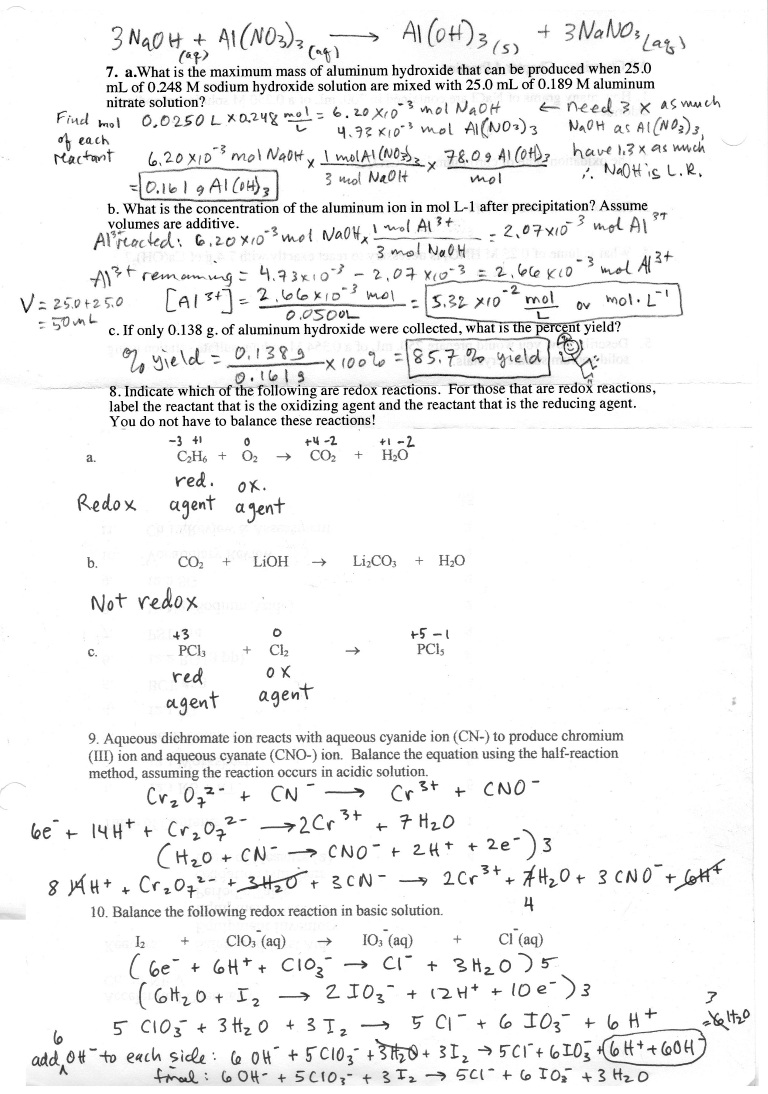
Answers to chapter 4 practice
Monday
Gravimetric Lab reports due
Objectives: students will be able to
1. Balance chemical equations
2. identify oxidation and reduction in redox reactions
Procedure: cover sections in Silberberg to meet objectives.
Tuesday/Wednesday
Objectives: students will be able to
balance redox reactions in acidic and basic solutions using the half-reaction method
Procedure: Balance redox reactions. If time allows, students will perform a redox titration.
Homework: work on these exercises: pp. 168-171, 52, 63, 65, 67, 71, 86, pg.
942 13 a, c, 15 b, c, 17 a, due Thursday for review.
Thursday
Objectives: students will be able to
1. identify products of elemental redox reactions
2. balance redox reactions in base using the half-reaction method
Procedure:
Finish redox, review for a test on chapter 4.
Homework: study for a test on chapter 4.
Friday
Objective: students will demonstrate comprehension of the concepts covered
in chapter 4 by taking a test.
Procedure: administer chapter 4 test.
Week of September 22
Monday/Tuesday
Objectives: students will be able to
1. define molarity
2. calculate molarity of a solution
3. prepare a solution of a given molarity
4. execute stoichiometric calculations involving precipitation reactionssolve titration problems
5. characterize oxidation-reduction reactions
Period 14 on Monday: go over and practice solubility rules.
Procedure: cover sections 4.4 & 4.5 in Silberberg.
Wednesday
Objectives: students will be able to
1. identify products of elemental redox reactions
2. balance redox reactions in base using the half-reaction method
Procedure: continue with sections in Silberberg to achieve objectives.
Homework: Gravimetric Analysis lab report due on Monday, September 29
Week of September 15
Monday
Quizzinger on chapters 1-3.
Monday/Tuesday
Objectives: students will be able to
1. write balanced equations for reactions
2. explain the polar nature of water
3. distinguish between strong and weak electrolytes
4. recognize and classify types of reactions
5. define molarity
6. calculate molarity of a solution
7. prepare a solution of a given molarity
8. execute stoichiometric calculations involving precipitation reactions
Procedure: Start chapter 4, cover sections 4.1-4.3 and 3.5 (molarity) in Silberberg
Homework: work on these exercises: pp. 166-168, 5, 17 a, b, 32, 34, 36, 38, pg. 127 (chapter 3, on molarity), 93, 95 due Friday.
Wednesday/Thursday
Objectives: students will be able to
1. Quantitatively precipitate a chloride salt
2. Dry and weigh the product
3. Determine the amount of chloride in an unknown salt.
Procedure:
Students will perform Experiment 8 in Nelson and Kemp, Gravimetric
Analysis of a Chloride Salt.
Friday
Objectives: students will be able to
1. identify products of elemental redox reactions
Procedure:
Students will weigh silver chloride samples
to complete their lab experiment. Then discuss types of redox reactions.
Homework due next Wednesday: write up gravimetric lab report.
Week of September 8
Monday-Wednesday, single periods
Objective: students will be able to
1. calculate the number of atoms, moles in a sample
2. calculate molar mass, percent composition
3. find empirical and molecular formula
4. solve stoichiometry problems
5. balance equations
6. calculate masses of reactants, products
Procedure:Review chapter 3 on stoichiometry, cover the sections in Silberberg to accomplish the objectives. Examples will be distributed for practice.
Tuesday/Wednesday, double periods
Objectives: students will get into lab groups, check lab drawer
inventory. Students will be able to use basic laboratory equipment
and work safely in a laboratory environment.
Procedure: discuss lab safety, assign lab groups, discuss lab
reports, lab policy, expectations. Go over Lab Book/Report policy.
Students will perform lab exercise #1, Basic Laboratory Equipment
Homework: write up lab, due next Tuesday.
Thursday
Objective: students will be able to
1. calculate the number of atoms, moles in a sample
2. calculate molar mass, percent composition
3. find empirical and molecular formula
4. solve stoichiometry problems
5. balance equations
6. calculate masses of reactants, products
Procedure:Review chapter 3 on stoichiometry, cover the sections in Silberberg to accomplish the objectives. Examples will be distributed for practice.
Friday
Quiz on chapters 1, 2 and 3
Week of September 2
Monday Labor Day, no school
Tuesday
Objective: students will be able to
1. state course goals and expectations
2. observe several chemical changes in a test tube
3. state the scientific method, discuss the role of the chemist in society.
Procedure:
1. Take roll, assign seats, give overview of the course, including goals and
expectations. Distribute course outline, rules, department safety and conduct
rules.
2. Review the scientific method
3. Conduct a chemistry experiment. Students will add a common iron nail to
copper sulfate solution. The students will observe changes
in the test tube.
4. Confirm book distribution.
Homework: Read course outline, obtain notebooks.
Wednesday
Objectives: students will be able to
1. report answers to the correct number of significant figures
2. solve problems with focus on units and conversion factors
Procedures:
1. complete chemistry experiment (iron in copper sulfate)
2. begin chapter one, chemical foundations. Go over chapter one summer assignment.
3. Hand out follow-up exercises, to be completed in class, or for homework.
Thursday/Friday
Objectives: students will be able to
1. report answers to the correct number of significant figures
2. solve problems with focus on units and conversion factors
3. examples: temperature conversion and density
4. discuss the early history of science,
state the contributions of Dalton, Thompson, Rutherford.
Procedures:
1. Continue with chapter one, chemical foundations. Go over chapter one summer assignment.
2. Hand out follow-up exercises, to be completed in class, or for homework.
3. Go over chapter 2 summer assignment, hand out follow-up assignment.
Homework: The procedure for Experiment 1, Basic Laboratory Equipment, will be distributed so that students may read it and include the procedure in their lab books.